Pages

Showing posts with label Library Classification. Show all posts

1 January 2021

LIS Notes for Copmpetitive Examination - 29:Mnemonics Devices in Library Classification


In library classification, the mnemonics means the power of adding the memory that means some of its notational symbols have more or less the same significance through out the classification schedule. Colon classification scheme is best example of mnemonics. Dr. S R Ranganathan has used four types of mnemonics in colon classification.

(a) verbal mnemonics

(b) schedule mnemonics

(c) seminal mnemonics

(d) systematic mnemonics


Verbal mnemonics

Verbal mnemonics is the letter for notational symbol for a class and subclass. So the verbal mnemonics consist in representing a class by first or more letter generally maximum three letters in the name. First letter should be English capital and after may be small but only alphabet are used. For example

(According to Colon Classification 6.0)

Basmati Rice J381 B

Begmi Rice J381 Be


Scheduled mnemonics 
 
Scheduled mnemonics can be defined a systemic list of divisions, tables or parts of schedules. According to Dr. Ranganathan , “a scheme of classification should include a preliminary set of schedules of isolate likely to occur in any array of some order or other of all or several classes or it should refer any recurrent sets of isolates to the one schedule of them given in connection with an appropriate basic class”.

Scheduled mnemonics consists following devices

(1) Common isolate Device

(2) Geographical Device

(3) Chronological Device

(4) Subject Device

(5) Facet Device

(6) Phase Device

Examples:


Encyclopedia of social science SZk

Flora of India I:12.44

Fauna of India K:12.44

Anatomy of neck L17:2

Anatomy of eye L184:2


Seminal mnemonics

Seminal mnemonics means specified digit should be seminally equivalent to entire schedule that means the same concepts is represented by the same term and also same number in entire schedule, if any conflict occurs, then we simply say that particular classification schedule ignore this concept. In colon classification entire schedule divide into seminal mnemonics such as

Number Meaning

1 Fundamentals, preliminary, persons
2 Structure, parts, forms, constitute
3 Function, syntax, method analysis
4 Fault, disease, pathology
5 Liquid, blood, environment
6 Money, finance, evolution, movement
7 Personality, composition, growth, produce
8 Management, organization


Systematic mnemonics

Systematic mnemonics represent the sequence of isolate in array that means the schedule arrange according to some rules such as later-in-time, arrangement of isolates according any principles. Colon classification gives well defined systematic mnemonics such as in Medicine Main Class(L) the class number arranged according to human body structure from upper parts to lower. Space schedule arranged according to most nearest to far distance. Similarly we can also examine the main class Psychology(S), the personality facet [p] are arranged according to growth such as new born, toddler, boy, middle age and old age.

Source:http://www.lislinks.com/forum/topics/mnemonic-device

LIS Notes for Competitive Examinations 21 : Dewey Decimal Classification ( DDC ) Editions

Full Edition

-------------------
First Edition -1876
Second Edition - 1885
Third Edition - 1888
Fourth Edition - 1891
Fifth Edition - 1894
Sixth Edition - 1899
Seventh Edition - 1911
Eighth Edition - 1913
Ninth Edition - 1915
Tenth Edition - 1919
Eleventh Edition - 1922
Twelfth Edition - 1927
Thirteenth Edition - 1932
Fourteenth Edition - 1942
Fifteenth Edition - 1951
Sixteenth Edition - 1958
Seventeenth Edition - 1965
Eighteenth Edition - 1971
Nineteenth Edition - 1979
Twentieth Edition - 1989
Twenty First Edition - 1996
Twenty Second Edition - 2003
Twenty Third Edition - 2011

Abridged Editions
-------------------------------
First Edition - 1895
Second Edition - 1915
Third Edition - 1926
Fourth Edition - 1929
Fifth Edition - 1936
Sixth Edition - 1945
Seventh Edition - 1953
Eighth Edition - 1959
Ninth Edition - 1965
Tenth Edition - 1971
Eleventh Edition - 1979
Twelfth Edition - 1990
Thirteenth Edition - 1997
Fourteenth Edition - 2004
Fufteenth Edition - 2012


LIS Notes for Competitive Examinations 17 : List of Library Classification Schemes


Dewey Decimal Classification – 1876 – Melvil Dewey

Expansive Classificatgion – 1891 – C A Cutter 

Library of Congress Classification –1904 – Library of Congress 

Universal Decimal Classification—1905 – Paul Otlet and Henry La Fontain 

Subject Classification—1906 – J D Brown

Colon Classification—1933 – S R Rangananthan

Bibliographic Classification—1935 -- H E Bliss 

Riders Internation Classification—1961 – A F Rider 

Broad System of Ordering—1978 – FID & UNESCO

27 December 2020

LIS Notes for Competitive Examinations 13 : Indicator Digits in 7th edition of Colon Classification


Symbol

Name of the Indicator Digit

Role of the Indicator Digit

*

Asterisk

Indicates Agglomeration and Interpolation

←

Backward arrow

Indicates backward range

→

Forward arrow

Indicates forward range

"

Double inverted comma

Indicates common isolates

&

Ampersand

Indicate phase relation

'

Single inverted comma

Indicate time facet

.

Dot

Indicates space facet

:

Colon

Indicates energy facet

;

Semicolon

Indicates matter facet

,

Comma

Indicates personality facet

-

Hyphen

Indicates spectator of kind 1

=

Equal sign

Indicates spectator of kind 2

+

Plus sign

And, addition


LIS Notes for Competitive Examinations 12 : Mapping of subjects in Colon Classification


z - Generalia

1 - Universe of Knowledge

2 - Library Science

3 - Book Science

4 - Mass Communication

8 - Management


A - Natual Sciences

B - Mathematics

C - Physics

D - Engineering

E - Chemistry

F - Technology

G - Biology

H - Geology

I - Botany

J - Agriculture

K - Zoology

L - Medicine

M - Useful Arts


Δ - Spiritual Experince and Mystisicm


N - Fine Arts

O - Literature

P - Languages

Q - Religion

R - Phylosophy

S - Psychology

T - Education

U - Geography

V - History

W - Political Sciences

X - Economics

Y - Sociology

Z - LaW


26 December 2020

LIS Notes for Competitive Examinations 11 : Notation system in Colon Classification

The notations are symbols used to represent subjects in a classification system. In colon Classification mixed notation is used. It include;

  • 23 Roman small letters - a to z (i,l and o are excluded)

  • 10 Indo-Arabic numerals - 0 to 9

  • 26 Roman Capital Letters - A to Z

  • Bracketed numbers ( Numbers in Parenthesis) - Part of a class number derived by subject device will be bracketed numbers. For example - for the subject 'Hindu Law' the class number is Z, (Q,2). here 'Z' is the number for Law, the Basic Class and (Q,2) is for Hindu Religion, the number has derived via

  • Indicator digits like * ” ← ) & ‘ . ; ,-= + → (


Empty Digit

To increase the capacity of an Array ( The classes having co-ordinate status) Colon Classification has introduced empty digits. Z, 0 (Zero) and 9 are used to represent empty digits. They has no semantic value but possessing ordinal value.

25 December 2020

LIS Notes for Competitive Examinations 10 : Colon Classification Introduction


Colon Classification (CC) was developed by Dr. S R Ranganathan in 1933.


It is the first ever faceted classification or analytico-synthetic classification.


Its name "colon classification" comes from the use of colons to separate facets in class numbers. there was only one symbol colon in earlier editions.


There were seven editions since 1987. The first six editions were edited by Dr S R Ranganathan himself and the seventh edition was edited by Professor M.A. Gopinath.


Editions of Colon Classification

  • First edition- CC was developed from 1924 to 1928 and initally used in Madras University. It was first published in 1933 by Madras Library Association. It has three distinct part;

    127 pages of rules explaining the underlying principles

    135 pages of Schedule

    106 pages of Index

  • The second edition in1939.The edition added a part 4 which contained about 3000 examples, which were illustrated in the rules given in the Rule part.  A new main class 8 Spiritual Experience and  Mysticism introduced.

  • The third edition in 1950. Different kind of phase relations with connecting symbols introduced.

  • The fourth edition in 1952. In this edition the facets PMEST ( Personality, Matter, Energy, Space and Time) introduced for the first time.

  • The fifth editon in 1957. This edition was proposed as two volumes of basic and depth versions, but only basic version only was published.A new part was introduced giving details for phase and inter-facet relation was given as chapter - 7.Empty and emptying digits were introduced.

  • The sisth edition in 1960. It was republished in 1963 with some amendments. It is the most popular and stable edition of CC.

  • The seventh edition in 1987. The only edition which was note edited by Dr. S R Ranganathan and edited by Professor M.A. Gopinath. The are five parts in this edition;

    Part A - Introduction 

    Part B - Guidelines to the Beginner  

    Part C - General Rules

    Part D - General Division and  Common Isolates

    Part E - Special Isolates


    Three versions of Colon Classification

  • Rigidly Faceted Era: The first three editions of Colon Classification (1933,1939, 1950) is known as rigidly faceted era. In these editions the facet formula was rigid and predetermined. The colon was the only connecting symbol for all the facets.

  • Analytico -synthetic Era: Fourth, Fifth and Sixth (1952,1957,1960) editions of CC is known as Analytico -synthetic Era. The PMEST were introduced and different connecting symbols were introduced for each facet.

  • Freely Faceted Era: The 1963 and 1987 editions are known as freely faceted era. During this period the CC became more flexible. 


18 December 2020

LIS Notes for Competitive Examinations 9 : Library Classification Introduction

The word Classification derived from the Latin word Classis.

The Library Classification used in the arrangement of documents in the library and the catalogue of it. While Bibliographic Classification is a scheme of classification which use to arrange all bibliographic databases.

Definitions

  • Margaret Mann defines "Classification is the act of arranging things according to their likeness and unlikeness. It is a sorting or grouping of things."
  • According to Richardson "Classification is putting together like things."
  • Berwick Sayers defines library Classification as "The arrangement of books on shelves or description of them, in a manner which is the most useful to those who read."
  • New Encyclopedias Britannica defines library classification as "a system of arrangement adopted by a library to enable patrons to find its material quickly and easily."

The purpose of library Classification : Helpful sequence, Correct replacement, Mechanised arrangement, Addition of new documents, weeding out, preparation of library catalogue, preparation of Index, etc 


Division of Subjects (Universe of knowledge)

  • Basic subject: A subject without any isolate idea as components. Example - Mathematics, Physics, History, Library and Information Science, etc.


  • Compound subject: A subject with a basic subject and one or more isolate ideas as components. Example- Mining of Coal, History of Literature, Treatment in Ayurveda, etc


  • Complex subject: A subject formed by coupling two or more subjects expounding, or on the basis of some relation between them. According to Ranganathan, “if a document or a work deals with or contains description of interrelationship, comparison, etc. among two or more basic subjects or compound then such a subject of the work or document is deemed to be of type complex subject.” Example - Statistics if Election in India, Impact of Space Science in Agriculture, Education in Economic Growth, etc.

In a Library Classification System notations are used to represent subject of documents to be arranged, in order to get an ordinal sequence. A notation is an ordered serial number of symbols representing terms or subjects.

Dr. S.R. Ranganathan, defines notational system as “a system of ordinal numbers used to represent the classes in a scheme for classification”.


Types of Library Classification

  • Universal Classification Schemes : Covers all subjects (Universe of Knowledge). Example Dewey Decimal Classification (DDC), Universal Decimal Classification (UDC), Library of Congress Classification (LCC), etc.
  • Specific Classification Schemes: Classification for  a particular subject area or group of subject or for a particular types of materials. Example: National Library of Medicine Classification (for Medicine), British Catalogue for Music Classification ( for Music), Dickinson Classification (for Music), Iconclass (for Art), etc.
  • National Schemes: A classification scheme specially designed for a country is come under National Schemes. Example: Swedish Library Classification System


According to functional formation of classification system it can be  classified as ;

  • Enumerative  System: Subject headings are arranged alphabetically and numbers are given to each subject.Example Library of Congress Classification System.
  • Hierarchical: The subjects are arranged hierarchically from most general to most specific. Example: Dewey Decimal Classification
  • Faceted Classification / Analytico Synthetic Classification: Subjects are arranged as facets and the class number is formed by synthesizing them according to specific  rules. Example Colon Classification , Universal Decimal Classification. 

31 March 2019

'Classify': an online tool for library classification


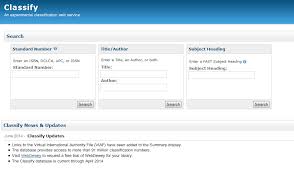
Online Computer Library Center is the provider of 'Classify' a web based catalogue information of books and other information sources world wide. The Classify helps librarians to ease their classification work . Only the metadata/citation is provided in 'Classify' . It provided DDC and LC classification numbers. Access Classify at http://classify.oclc.org/

Dewey Decimal Classification ( DDC ) System: Summaries

Main Classes

000 Computer science, information & general works
100 Philosophy & psychology
200 Religion
300 Social sciences
400 Language
500 Science
600 Technology
700 Arts & recreation
800 Literature
900 History & geography

For further subdivisions visit https://www.oclc.org/

Indian Institute of Management Kozhikode (IIMK) Library Attendant Recruitment

🔹 Vacancies: 01 🔹 Qualification: Plus Two / Equivalent 🔹 Experience: 2 years of office experience 🔹 Maximum Age: 28 years 🔹...